
Analysis
Utrecht's Car-Free District Will Hand Its First Parking Spaces to Its Most Expensive Homes
The €240 tariff in Merwede has been argued about for a year. The more consequential arrangement has not: at first issue, developers themselves decide which homes a parking space comes with, and the project's own manager expects them to land with buyers of the larger free-sector homes. That, the 5.2 megawatt ceiling, a cancelled bridge tender and a residents' organisation that does not yet exist are what the paperwork actually says.
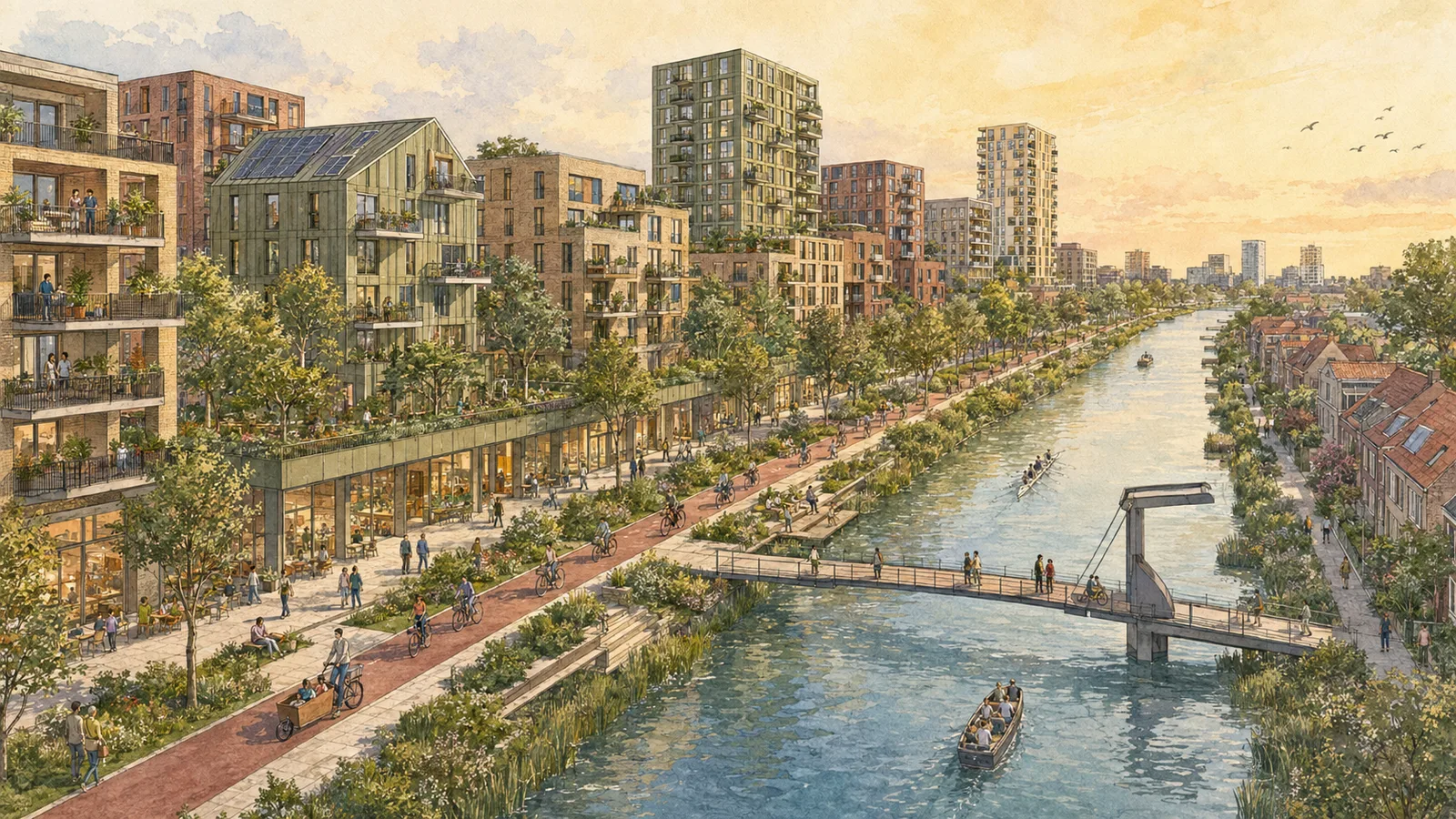
Utrecht is building a neighbourhood on the premise that most of the people living in it will not own a car. Merwede, twenty-four hectares of former industrial land along the Merwedekanaal, is planned for 6,000 homes and about 12,000 residents, with no ordinary street parking anywhere in it and a formal norm of 0.3 spaces per dwelling.
Nobody lives there yet. The first pile went in on 3 March 2025; the first homes are due in 2027, slipped from an earlier target. By the end of 2025 seven blocks were under construction — more than 2,700 homes and over 26,000 square metres of amenities, including two supermarkets, a health centre, childcare, sport and a mobility hub. The first phase is not expected to be complete until 2030. There is no retail performance to measure, no resident profile to describe, no delivery traffic to count.
What there is, is paperwork. And the paperwork has moved considerably in the last year, in ways that have not been reported. A council progress letter of 7 May 2026 confirms that the entity managing the district's electricity was founded only at the end of 2025, that the organisation which will run package delivery in a car-free district has still not been founded at all, and that the procurement of two of the walking-and-cycling bridges the concept depends on has been halted because it could not be done within budget.
None of that makes Merwede a failure. It is the most carefully specified attempt at this in the Netherlands, and the people building it have been considerably more candid about its weak points than the brochures are. But the public argument has fixed on the wrong number.
The tariff, and what it should be compared to
A garage subscription in Merwede is expected to cost around €240 per space per month at 2025 prices. This has been on the project's own website for more than a year; the city has not hidden it. Residents can apply only once their home is delivered and they are registered at a Merwede address, and most spaces float — a subscription buys access to a garage, not a bay. A limited number of fixed bays are available at a surcharge.
€240 a month is roughly €2,880 a year. Against a conventional Utrecht street, that looks punitive. The city's own parking tax schedule for 2026 sets a first residents' permit in zone A2 — the zone whose boundary runs along the Merwedekanaal, the Kanaalweg and the even side of the Europalaan, which is to say along Merwede's own edge — at €32.37 a month, or €97.11 a quarter. A resident of the streets immediately across the water pays that. A resident of Merwede pays €240. The same car, a few hundred metres apart, at roughly seven and a half times the price.
Against the cost of the car itself, it looks different. The Nibud puts total monthly car costs — depreciation, insurance, road tax, maintenance, fuel — at between €356 for a mini-class car and €703.50 for a mid-range one, on figures from June 2025. Add €240 and a household at the lower end of that range sees its motoring bill rise by about two-thirds. At the upper end it is closer to a third.
Both framings are honest, and the piece of the argument that usually goes missing is the second one. €240 does not make car ownership impossible for a household that was already absorbing €400 a month. It makes it decisively harder for a household near the bottom of that range — which is, of course, precisely the household the fairness argument is about. The tariff is a real filter. It is not the sharpest one in the file.
The rule that decides who parks
The sharper one has been on the record since December 2023, in a specialist interview that appears not to have reached the general press.
Finn van Leeuwen, the municipal project manager for Merwede, explained to the specialist title Gebiedsontwikkeling.nu how the 1,500 or so private spaces will be distributed. The landowners in the collective each get to offer a share of the spaces, and at the first issue they may decide for themselves which homes those spaces are attached to. In practice, he said, a home can therefore be sold at a higher price with parking included. He expected the private spaces to be taken initially, for the most part, by free-sector renters and buyers of the larger homes, because the price will remain substantial.
Only after that first issue, Van Leeuwen said, do the spaces become available to anyone who applies.
That was 2023. The sales material now confirms it from the other side. Cix, one of Merwede's building consortia, tells prospective residents plainly that a portion of its homes carry the option of renting a space beneath the buildings — “een deel van de woningen heeft de mogelijkheid een eigen parkeerplaats te huren onder de gebouwen van Cix” — while everyone else uses the garages on the Europalaan by subscription. The two-tier arrangement is not a projection. It is being sold.
This is a different mechanism from a price. A price rations by willingness and ability to pay, and everyone faces the same queue. What is described here is an initial allocation made by the sellers, bundled into the product, and only afterwards opened to the general population of the district. Whatever one thinks of the outcome, it means the question "can a social tenant in Merwede get a parking space?" is answered less by €240 than by how many spaces are left when the free-sector product has been sold.
The municipality has not concealed this either. But it has not featured in the public argument at all, and it is the single most load-bearing fact about who Merwede is for.
A second distributional conflict sits alongside it, also on the record. Municipal policy is that disabled residents do not pay for their space. But Merwede has no public-space parking whatsoever — every space sits inside a developer's project — so the city is simultaneously the party setting that policy and a shareholder in the company that depends on parking revenue. The developer Martijn Stemerdink of JaJo put the tension bluntly in the same interview: the policy is fine, but why should the private parties fund it? Van Leeuwen's own retrospective view is that a harder separation between public and private tasks, agreed and priced up front, would have been simpler. Just over 30 accessible spaces are planned in the first phase's garages.
The argument Utrecht has already had
The price, at least, has been fought over in public. On 27 February 2025, on the EO's “Dit is de Dag” on NPO Radio 1, alderman Eelco Eerenberg appeared opposite Marcel Hanegraaff, a political scientist, under the programme's own framing: a place for everyone, or a homogeneous neighbourhood?
Hanegraaff's argument was that a car-free district excludes people whose work depends on a vehicle — he named plumbers and carpenters — and that renting a fixed space costs around two hundred euros a month on top of everything else. Policy of this kind, he said, widens the gap between social groups. His figure was if anything conservative: Merwede's published tariff is €240, and that buys a floating space, with a surcharge on top for a fixed bay of the sort he was describing.
Eerenberg did not dispute the cost. He pointed to shared cars, conceded the obvious — of course people say they would rather park close to home — and argued that a car-free district is not by definition a district for progressive residents. That last proposition has since been tested. An ANWB survey of more than a thousand residents of strongly urbanised areas, published in early 2026, found that 44 per cent of car owners would accept parking further from home and a longer walk — but only if the space freed up in the street is genuinely turned over to greenery and liveability. Fewer than half, in other words, and conditionally. The same survey found 26 per cent feel unsafe on the walk home from where they park.
Both things can be true. The question the exchange leaves open is which households are in a position to make the trade. A resident who can genuinely replace car trips with cycling and transit gains from this plan. A resident who cannot — shift work outside tram hours, care responsibilities across town, a job in a business park — faces a fixed monthly cost a conventional neighbourhood would not have imposed, and a queue for a space that opens only after the free-sector product has been served. Reducing car dependence and pricing car access out of reach produce identical parking statistics and entirely different household budgets.
The neighbours are already paying
The displacement worry — that Merwede's cars will end up in Rivierenwijk, Kanaleneiland, Transwijk and Dichterswijk — has been raised by residents of those districts from the beginning, and the city's stated answer is monitoring: a liveability impact report with traffic counts and the possibility of adjustment.
But something more concrete has already happened. Paid parking was introduced in the adjacent neighbourhoods early, ahead of the schedule it would otherwise have followed, and the municipal decision-making from October 2021 is explicit that this was partly to prevent a parking exodus from Merwede.
That reframes the fairness question rather than settling it. The surrounding neighbourhoods have not been left to absorb the overflow; they have been given a tariff of their own in advance, to protect a district none of them live in. Whether that is prudent planning or a cost exported to existing residents is a political judgement. It is not monitoring, and it should not be described as though the city has done nothing but promise to watch.
The grid sets a second ceiling, and it works differently than reported
There is a limit on Merwede that has nothing to do with parking, and it is stricter than the parking norm.
Utrecht's electricity grid is officially closed to new demand, and the Merwedekanaal substation next door is congested. Merwede is being built anyway, and it is worth saying plainly that its first phase is settled: the arrangement was approved in principle by Stedin, the national operator TenneT and the regulator ACM, and it is not in question. Nobody moving into Merwede in 2027 will be waiting for a connection.
What made that possible is what is described as the first group energy contract of its kind in Europe. The area has a hard net limit of 5.2 megawatts — roughly the peak the grid operator would expect from the first phase's 4,250 homes alone, if each had an individual air-source heat pump. Inside that envelope must also fit the schools, the supermarkets, the health centre, the garages with their chargers, and the collective heat-and-cold storage system that heats the district.
The mechanism is more specific than "the district has been capped," and the distinction matters. Households are small-consumer connections and are not themselves parties to the group contract. The contract binds the large connections — amenities, chargers, the heat system — which under this arrangement each get their own connection from Stedin but no individually allocated transport capacity. They can only obtain capacity through the group, and pay the area entity for it. Household consumption eats into the same 5.2 megawatt envelope without households being bound by anything.
So the risk of the cap does not fall on residents directly. It falls on the amenities. If Merwede's homes consume more than modelled — more induction, more home working, more heat-pump demand in a cold snap — the squeeze lands on the supermarket, the health centre and the chargers, because they are the parties contractually obliged to stay under the line. That is a genuinely novel allocation of risk and it deserves to be described accurately.
Two consequences follow. The first is that the collective heat system is not an amenity but a condition of the district's existence: the whole arrangement only fits under 5.2 megawatts because the homes are not individually heated. Residents will be tied to a single heat supplier by the same mechanism that made construction legally possible, and that belongs in any honest account of what living in Merwede costs.
The second is a timetable problem. The entity that holds the contract — the Energiehub Merwede Coöperatief — was established only at the end of 2025. As of the council letter of 7 May 2026, the service providers who will actually monitor the net limits were still being contracted, described as work for "the coming months," so that the Energiehub can meet its obligations when the first residents move in during 2027. That is not a scandal. It is a thin margin on the load-bearing piece of infrastructure, and it does not appear to have been reported.
Phase two is not covered, and the denominator is moving
The contract covers the first phase. The second phase — some 1,750 homes, plus a primary school, a gymnasium and childcare at the neighbourhood square — had its Nota van Uitgangspunten adopted by the council on 18 December 2025. The city aims to put a draft Omgevingsplan out for inspection at the end of 2026 and bring it to the council in 2027, with construction from 2031. The Merwedekanaal substation upgrades are phased across the early 2030s.
The 5.2 megawatt figure was not a Merwede-wide allowance that phase two can grow into. It was derived as the operator's expected peak for phase one's homes — which means, by construction, that it does not include phase two. So one of three things has to happen, and no published document says which. The ceiling is raised under a new agreement with Stedin. Or phase two is somehow fitted underneath the existing envelope, which for 1,750 homes plus a school seems optimistic. Or phase two waits on the substation works in the early 2030s, which would put a decade between the first residents and the last.
There is a further wrinkle. The group contract was permitted as a pilot; Stedin has said that applying such contracts structurally would require a change in the law. Whether phase two can be brought under the same construction, or needs a different one, is not a question the project documents address.
In a city where connection queues are the binding constraint on housing, none of this is a detail. It is also answerable today, by Stedin and by the project team, and it has not been asked in public.
Meanwhile the number of homes is quietly rising while the parking count stays fixed. The May 2026 letter reports the outcome of two studies the council commissioned: around 100 additional non-self-contained student units on top of the 10,900 already set for the wider Merwedekanaalzone, and roughly 32 to 34 extra front doors within phase one's existing building volumes, plus 60 to 66 protected care units in the same block now counted as dwellings for traffic purposes. In each case the letter records that the addition was assessed against the traffic and mobility framework and judged to fit. It does not record an assessment against the energy envelope — which is the constraint that binds harder.
Do those additions fit? On their own terms, probably. Students are excluded from the discounted remote-parking scheme, and care units generate little car traffic. But the arithmetic is worth stating plainly: the parking supply is a fixed number of built spaces, and the number of homes sharing it is being increased. The 0.3 norm is not a ratio that will be maintained; it is a ceiling on spaces that everything else is being fitted underneath. One in four homes is the optimistic version.
The bridges
Here is the finding we have seen reported nowhere, and it goes to the heart of the concept.
Merwede's bargain is that residents give up the car and get cycling and walking connectivity in exchange. Two new movable walking-and-cycling bridges over the Merwedekanaal are part of that exchange, and two houseboats were bought and are being relocated this year — one to the Billitonkade in spring 2026, one near the Noordersluis in autumn — specifically to make room for them.
The tender has been stopped. A quality review conducted before the next procurement stage concluded that it could not continue in its current form because of the financial preconditions. There was no single cause: the required clearance height and width for rowers, the passage requirements for houseboats and historic vessels, and the design ambition for a slender, unobtrusive bridge together produce a long span and a technically complex, expensive structure that does not fit the project budget. A basic variant is now being worked up to see whether two bridges can be built within both the money and the conditions the council itself attached in 2021 and the 2022 rowers' covenant. The city expects to report back in the autumn.
This is the mobility concept's own infrastructure, being value-engineered under budget pressure, with the first residents arriving next year. If the bargain is that you cycle instead of driving, the quality of the cycling connections is not a nice-to-have. It is the consideration.
The amenity stagger
Utrecht has run this experiment before, and the results are on the record.
The first pile for Leidsche Rijn went in on 4 December 1997; the first keys were handed over on 14 October 1998. Leidsche Rijn Centrum, the district's centre, opened on 16 May 2018 — nineteen and a half years later. It arrived smaller than planned. Two-thirds of retail chains had shown no interest in the centre while it was still under construction, and its own future owner argued for shrinking it — more a neighbourhood facility, the company said, than a city-district centre. The anchor tenant, a V&D, went under before the doors opened; a Jumbo food market took the space instead, over the objections of shopkeepers who feared it would absorb their trade.
Then it struggled anyway. In 2021 the centre was formally designated a vulnerable retail area by the municipality, partly on account of structural vacancy. In 2023 the owner, a.s.r., asked the city to let it change the mix — more hospitality, more food, a second supermarket — describing one of its squares, the Hof van Bern, as still feeling cold and unwelcoming, while noting that the Brusselplein performed adequately. The vacancy became visible around five years after opening, which is also the length of a standard Dutch retail lease. In 2025 the centre changed hands, sold to Maven Real Estate.
Set Merwede's timetable against that. First residents in 2027. First phase complete in 2030. Second phase, with its primary school, starting construction in 2031 at the earliest. A household moving in during the first year will spend the better part of a decade inside a building site.
And this is not an inference. The municipality says so itself. The May 2026 letter notes that pressure on space is already high, that every available square metre is in use for site huts, construction roads, cranes and storage, and that this pressure will increase further when the first homes are delivered — with the result that meeting spaces and play areas in the public realm cannot be laid out in their final form straight away. The city's response is temporary: a cinema, a temporary venue, and an exploration of a provisional adventure playground in response to a council motion.
Merwede's amenity plan is genuinely stronger than most. Two supermarkets, a health centre, childcare and sport are in the first phase, and 26,000 square metres of facilities are already under construction rather than merely zoned. But zoning guarantees floor area, not tenants. Ground-floor retail in new high-density buildings carries expensive fit-out, high service charges, constrained loading and a customer base fragmented across phases. A chain can absorb a loss-making opening year; an independent baker cannot. Leidsche Rijn's centre is Utrecht's own evidence that a well-planned retail programme can arrive late, arrive smaller, and still struggle once it is there.
There is a related problem with the things that already exist. The council decided, by amendment in December 2025, that the creative, social and sporting initiatives on the old OPG site — Vechtclub XL, Boulderhal Sterk, Skatepark Utrecht, Circus Diedom, Wij 3.0 — should be retained in the area. The May 2026 letter sets out the financial consequence: in every scenario examined, housing costs after transformation will be considerably higher than the rents these organisations pay in the old halls, and there is no provision in the city's budget for either a structural or a one-off contribution. Hall L, which currently houses three of them, does not fit the plan and will not be kept. The council has instructed that they stay; the money to make that possible has not been found. Meanwhile the site itself has persistent problems with rough sleeping, and copper thieves stripping the buildings being demolished caused repeated power failures for the existing tenants.
In a conventional neighbourhood, residents bridge an amenity gap by driving somewhere else for a few years. Merwede removes that fallback by design. The instrument that keeps cars off the street also removes the compensation for amenities that have not opened yet.
The delivery system, run by a body that does not yet exist
Cars and vans are not meant to enter Merwede's interior. Goods arrive at edge hubs and travel the last stretch by light electric vehicle, handcart or resident, through package walls and service points. A district-wide owners' organisation — a kind of association for the whole neighbourhood — is to handle logistics, package reception and area maintenance, and its membership transfers with the property when buildings are sold. Unlike the mobility company, it is tied directly to the housing programme: sell a building and you sell a share of the organisation with it.
A car-free interior does not eliminate deliveries; it relocates and re-handles them. Merwede will still receive parcels and returns, supermarket and hospitality supplies, medicines, furniture, waste and recycling, tradespeople, and deliveries to residents who cannot collect a package themselves. Each flow gains a handling stage and an operating cost: reception and storage, staffing, maintenance of the walls, internal transport, loading coordination, security and liability. Future building owners and residents are expected to pay for these through membership. Van Leeuwen's own illustration of the principle was not about cars at all but about bicycles: parking a bike on the street costs almost nothing, whereas a bike garage needs supervision and cleaning, and someone has to pay for that.
Which brings us to a fact the May 2026 letter states in a single subordinate clause. The Gebiedsvereniging Merwede — the body that will organise package distribution in the car-free district and manage the visitor bicycle parking — is something the municipality will be setting up "in the coming months." As of May 2026, it does not exist.
The first residents arrive next year. The organisation that will receive their parcels, set their membership charge and run the logistics regime on which the whole car-free premise depends has not been founded, has no published operating plan, no published delivery windows, no published enforcement mechanism and no published tariff. Its charge will land on households, including social tenants whose service charges are regulated by what a landlord may lawfully pass on — a question nobody has answered in public.
What cannot be said is that the system is failing. It has not been tested. The verifiable finding is narrower and quite sharp enough: Merwede has designed a logistics regime whose throughput, enforcement and running cost are unproven, whose costs are already assigned to residents, and whose operator has not yet been incorporated.
The ten-year question, correctly stated
The Mobiliteitsbedrijf was set up in January 2023 by six landowner consortia together with the municipality. Each has a say in proportion to landholding and every decision must be carried by the collective. The shareholders have signed up to fund the company for ten years; after that it is expected to stand on its own. Leaving early is possible, under an exit arrangement tied to the residual operating risks.
The people building it are unusually candid about the economics. Van Leeuwen has said that letting the garages is a loss-making business — that a cost-covering tariff would put the monthly price beyond both residents and shared-mobility operators — and that not every landowner could have built a garage alone, so owners are building spaces next to their neighbours' homes and sharing the loss. His summary of the whole project is that it is expensive not only to build but precisely also to use.
Edvard Hendriksen, who directs the mobility company, has named the continuity risk directly: most landowners will eventually sell to a housing corporation, an institutional investor or private buyers, and the parties now in the room will lose their grip. He contrasts Merwede with Amsterdam's Strandeiland, where hubs and shared mobility are organised plot by plot — less efficient and less flexible, in his view, but also less dependent on everyone staying put.
It would be easy to conclude from this that the residents are the backstop in year eleven. The documents suggest something more specific, and it should be stated accurately.
The municipality intends to buy the mobility hubs from the landowners once they are complete, precisely in order to retain long-term influence — with the side benefit for developers that a buyer for the parking real estate is guaranteed. And the area organisation is structurally more durable than the mobility company: Van Leeuwen has acknowledged that the Mobiliteitsbedrijf could in theory fail in ten years, obliging the municipality to take over part of its tasks, while the area organisation would continue regardless. One plausible end state he has floated is that the mobility company ends up contracted by the area organisation.
So the transition risk is real but the shape of it is different from the obvious reading. The public sector is taking the asset — a structurally loss-making category of real estate, bought at completion, held indefinitely. The private consortium is taking the operating risk for a decade and then handing it on. And the residents are taking a subscription: to the garage, to the collective heat system, to the area organisation.
That is the actual innovation, and it is worth arguing about on its own terms. Something that used to be public infrastructure — parking paid for through taxation, on a kerb that belonged to everyone, with a permit regime and a right of appeal — has been reconstituted as a set of privately operated memberships sitting on publicly owned assets. It may well be a better arrangement: it is more honest about what parking costs, it frees an enormous amount of ground for other uses, and it is being built by people who understand its weaknesses. It is simply a different claim from the one in the brochures.
Van Leeuwen's own formulation is the right one to end on. In ten years, he has said, they will take stock and see what this complicated process has produced, for them and for the residents.
What we could not verify
This analysis rests on municipal planning and project documentation, council correspondence including the progress letter of 7 May 2026, the development consortium's published figures, and specialist and local reporting. Several things it would need to go further are not public.
The signed business plan for the Mobiliteitsbedrijf has not been published, nor its projected operating deficit, nor the terms of the exit arrangement, nor what happens contractually if shared-mobility demand comes in below forecast. The €240 figure is described as an expectation at 2025 prices; the indexation rule that will carry it to 2027 and beyond is not stated. The cheaper remote-parking option at P+R Westraven — about eight minutes away by bicycle, on the project's own reckoning — is described as much cheaper, but its tariff is not published alongside the Merwede one, and the scheme is rationed: one subscription per address, a fixed allocation per building block, students excluded.
On the grid, the share of the 5.2 megawatt ceiling already committed to heating, amenities and charging is not published, nor is the mechanism by which the Energiehub will actually curtail a large user that exceeds its allowance. Nor is it published whether any transport capacity has been reserved for phase two, whether the ceiling would rise if it were, whether phase two's timing depends on the substation works, or whether the pilot construction can be extended to it under current law. Nor whether the extra dwellings now being added to phase one have been assessed against the energy envelope at all. On the commercial side, the rent schedule and vacancy assumptions for the ground-floor units are not public, and neither is the tenant status of the two supermarkets and the health centre. On logistics, there is no operating plan and no organisation yet to publish one. The annex to the May 2026 council letter dealing with the future rents of the OPG initiatives has been placed under confidentiality, on commercial-sensitivity grounds, until the temporary lettings end. And the cost of the basic-variant bridge design will not be known until the autumn.
Two further sets of figures do not exist yet but will: allocation data for the social and middle-rent homes once occupation begins — including, crucially, how many of the roughly 1,000 resident spaces remain unallocated after the developers' first issue — and parking counts in Rivierenwijk, Transwijk, Dichterswijk and Kanaleneiland before and after, now that paid parking has been introduced there in advance.
The most useful disclosure would be the smallest: the trigger points at which the municipality would add parking, change tariffs or revise access. A plan that names the conditions under which it would change is a policy. One that does not is a hope.
We put these questions to the gemeente Utrecht and to Stedin on 8 August 2026, asking for a response by 21 August. We will update this article with any answers we receive.
Merwede is not a failed experiment, and nothing here suggests it will be. Its designers have been more honest about its weak points than its marketing has, and much of what is set out above comes from their own mouths. But it should be described as what it is: a large-scale experiment in urban governance, priced at €240 a month, capped at 5.2 megawatts, allocated first to the homes that pay most, and untested against a full neighbourhood of 12,000 people.
Sources
- Voortgang Merwede fase 1 en 2, toevoegen woningen, waardevolle functies en overige ontwikkelingen (kenmerk 34148527)
Published by Gemeente Utrecht
- De auto's de wijk uit, zo doen ze dat in Merwede
Published by Gebiedsontwikkeling.nu
- Merwede duurzaam en mobiel — parkeren, deelmobiliteit en tarieven
Published by Merwede (ontwikkelconsortium)
- Cix Merwede — veelgestelde vragen over parkeren
Published by Cix Merwede
- Dit is de Dag: nieuwe autovrije wijk in Utrecht — een plek voor iedereen of homogene wijk?
Published by NPO Radio 1 / EO
- Woningtekort aanpakken met autovrije wijk? 'Vergroot de kloof'
Published by EO
- Parkeerkosten: tarieven bewonersvergunning per zone, 2026
Published by Gemeente Utrecht
- Autokosten per maand
Published by Nibud
- Parkeren in sterk stedelijk gebied: ervaring en houding van bewoners
Published by ANWB
- Utrechtse netbewuste wijk krijgt als eerste groepscontract voor energie
Published by Stadszaken
- Netbewuste gebiedsontwikkeling Merwede: groepscontract en netgrens van 5,2 MW
Published by Núna Energy
- Bouw Utrechtse wijk Merwede loopt voorspoedig: 'eerste bewoners in 2027'
Published by De Utrechtse Internet Courant
- Gemeente maakt vaart met volgende fase woningbouw Merwede
Published by Gemeente Utrecht
- Leidsche Rijn heeft nu ook een echt winkelcentrum
Published by NOS
- Leidsche Rijn Centrum mag aanbod aanpassen in strijd tegen leegstand
Published by De Utrechtse Internet Courant
- Aanpak kwetsbare winkelgebieden
Published by Gemeente Utrecht
- Winkeliers Leidsche Rijn Centrum boos over plannen voor mega Jumbo
Published by De Utrechtse Internet Courant
- a.s.r. real estate verkoopt winkelcentrum Leidsche Rijn Centrum aan Maven Real Estate
Published by a.s.r. real estate