
Attributed reporting
Utrecht AI flags goat udder asymmetry and chicken wing fractures
PhD research at Utrecht University's veterinary faculty uses a milking-parlour camera to flag goat udder asymmetry and post-slaughter scans to identify chicken wing fractures.
Utrecht University says research at its Faculty of Veterinary Medicine has produced computer-vision models that analyse animal images for possible health and welfare problems. The work formed Kacper Libera's PhD thesis, awarded by Utrecht University on 29 October 2026. The university says he will continue at the faculty as a postdoctoral researcher.
Two uses, one approach
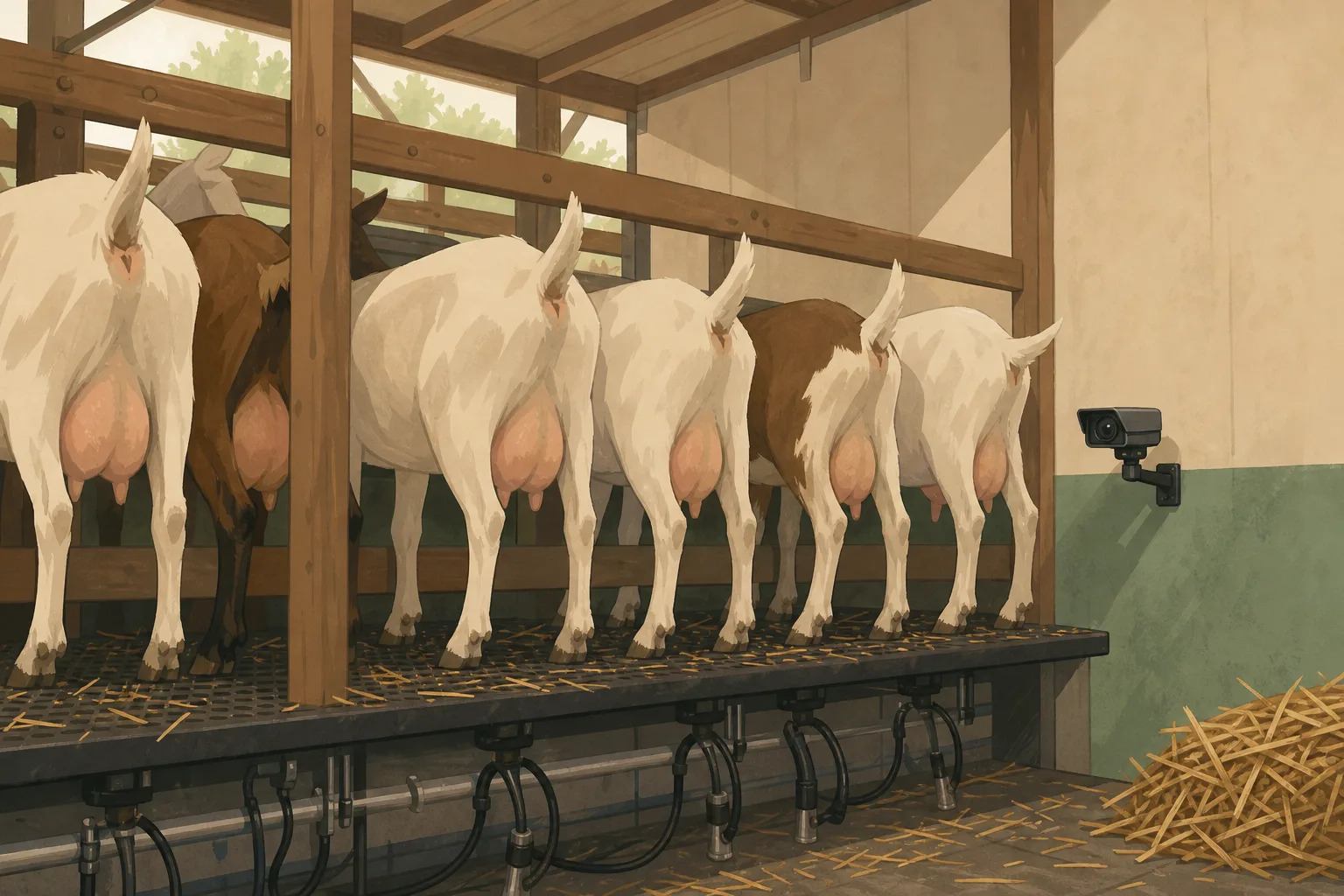
The university describes two applications of computer vision. The first concerns dairy goats. A regular camera films the animals' udders from behind while they are milked, and the model looks for asymmetry, which can indicate inflammation. Libera has turned the model into an app that would let a farmer see which goats may be affected, so that they can act, for example by changing housing, improving ventilation or vaccinating, according to the university.
The second application concerns poultry inspection after slaughter. Separate models analysed CT scans and photographs of wings collected from broiler carcasses, classifying fractures and bruises in study samples. These are post-mortem inspection results, not live monitoring of injured chickens. The researchers say such models could eventually help slaughterhouse inspectors trace welfare problems back through the supply chain.
What the published study shows
The goat work has been peer-reviewed. A paper by Libera and five co-authors in the Journal of Dairy Science (volume 109, issue 4, published April 2026), listed on Utrecht University's research portal, describes the method. The authors note that udder asymmetry in goats is often linked to mastitis, and that checking large herds by hand is impractical.
They trained a custom model on 4,321 annotated images of goat backsides, plus 373 background images, all collected on one farm over three days of milking. Two dairy goat veterinarians labelled each image as symmetrical, left-asymmetrical or right-asymmetrical. On an unseen test subset, the paper reports a mean average precision of 0.891 at the mAP50 threshold and 0.766 across the stricter mAP50-95 range. The abstract does not report simple accuracy or class-level precision and recall.
A separate peer-reviewed poultry study used 306 CT scans and 285 photographs of chicken wings. It reported 98 per cent accuracy for CT-based fracture detection, 96 per cent for photo-based fracture detection and 82 per cent for photo-based bruise detection. Those are study-dataset results, not measurements from routine production-line use.
The university's news item adds that there is no gold standard for udder asymmetry and that experts sometimes disagree. The team therefore labelled an image asymmetrical if at least one of the two experts judged it so, a choice meant to reduce the chance of missing sick animals.
Limits and next steps
The evidence is still early. The goat dataset comes from a single farm, and the university says the model is now being tested on additional farms because conditions differ. It reports Libera as saying the model performs about as well as human assessors, but the news item gives no figures for that comparison. The chicken study used collected post-slaughter wings rather than a live production line. One co-author was affiliated with Meyn Food Processing Technology, and the paper says the work was funded through an NWO UTOPIA grant.
The app is not yet available commercially. Libera says "a few steps" remain, and that large-scale use needs more research. He also stresses the limits of the technology: "The AI model is a tool, not a replacement for people," the university quotes him as saying, meaning farmers and veterinarians stay in charge of decisions.
Why it matters locally
The university says the average Dutch goat farm has about 1,000 animals, which makes checking each udder by eye hard. For Utrecht, the story is a small example of research at the university's veterinary faculty aimed at practical farm and slaughterhouse problems. The goat app is a prototype and the chicken models are research tools, not deployed systems. Readers should treat the promised benefits to animal welfare as the researchers' expectation until wider farm and production-line trials report.
Sources
- AI-model can detect health problems in animals
Published by Utrecht University
- Application of computer vision for food safety, and animal welfare and health monitoring
Published by Utrecht University Research Portal
- Automated detection of asymmetrical udders in dairy goats using a camera and deep-learning model YOLOv12
Published by Utrecht University Research Portal / Journal of Dairy Science
- Detecting wing fractures in chickens using deep learning, photographs and computed tomography scanning
Published by Utrecht University Research Portal / Poultry Science