
Attributed reporting
Bloembergen building turns 25 as Utrecht plans NMR upgrade
The Utrecht Science Park facility houses ten NMR systems and is included in a €3.4 million programme to upgrade the national NMR network.
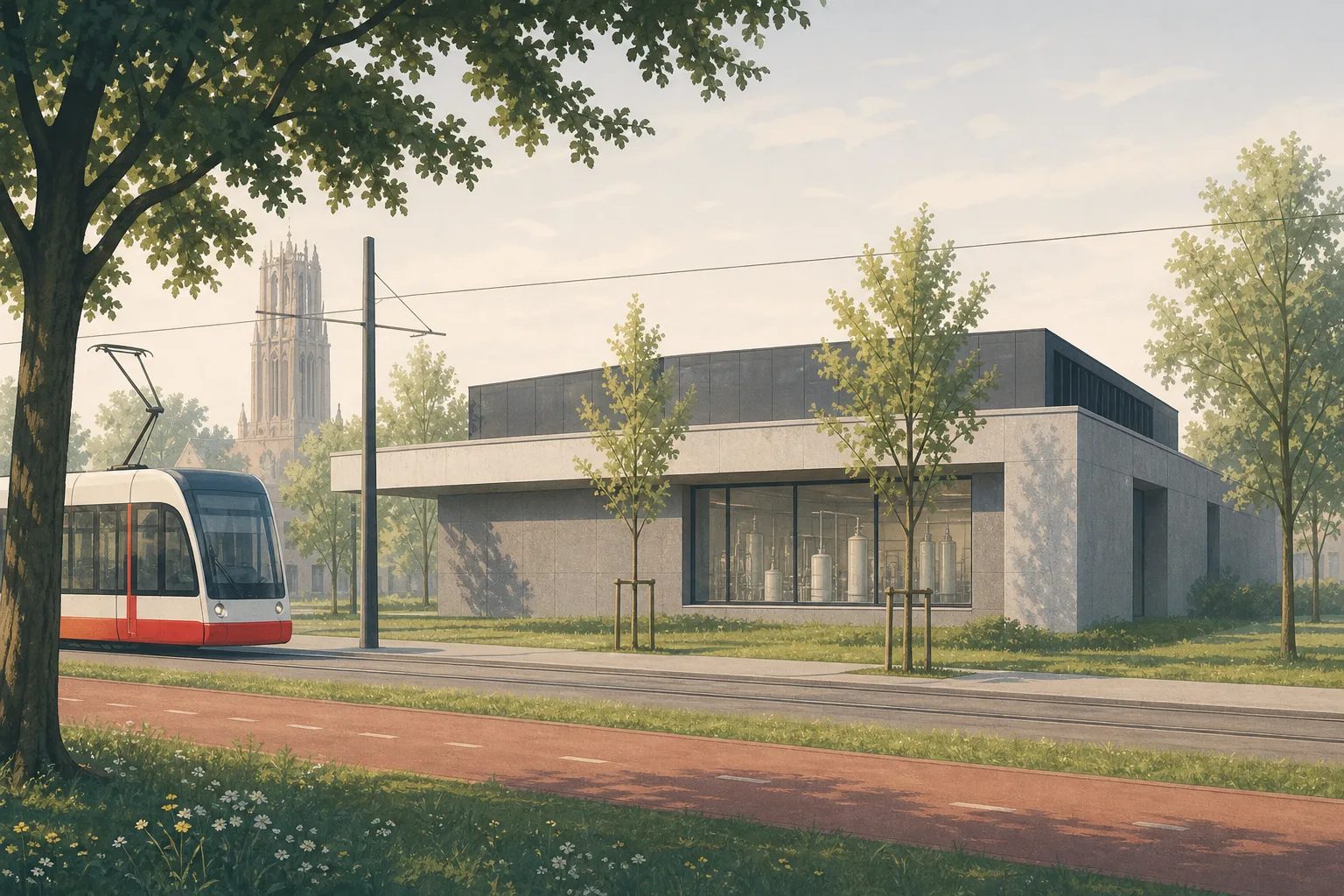
Most of what happens at Utrecht Science Park is invisible from the street. One example is the Bloembergen building, which Utrecht University marked as 25 years old on 2 November 2026. According to the university, it was built to house an extremely powerful magnet for nuclear magnetic resonance (NMR) research and now holds ten NMR systems.
What NMR does
The university explains that NMR works by aligning atomic nuclei in a strong magnetic field and disturbing them with radio pulses. The signals the nuclei give off as they settle back produce a molecular "fingerprint" that reveals a molecule's structure and how it moves. Stronger fields separate those signals more precisely.
The building was designed around a 21.15-tesla magnet, more than 4,000 times the strength of a typical fridge magnet, according to the university. Its newest system exceeds 28 tesla, making it one of the strongest in the Netherlands and a relative rarity worldwide. Researchers travel from abroad to use it.
Group leaders Alexandre Bonvin, Hugo van Ingen, Gert Folkers and Marcus Weingarth combine NMR with computational methods. Their work, the university says, contributes to research into new medicines and sustainable materials, as well as quality control in the pharmaceutical and food industries. It adds that although AI can predict protein structures, flexibility and movement also help determine how proteins function—properties that NMR can examine.
From a pig-barn neighbour to a dedicated building
The university's account traces the history to 1987, when emeritus professors Rob Kaptein and Rolf Boelens moved their NMR group from Groningen to Utrecht. The magnets were first housed on the seventh floor of the Kruyt building. One was too large and went to the Faculty of Veterinary Medicine, next to a pig barn; Bonvin recalls that ammonia from the barn showed up in the measurements.
Around 2000, an NWO grant funded a 900 MHz spectrometer, which led to plans for a dedicated building. A 1.2 GHz spectrometer arrived in 2021; Utrecht University describes it as the most powerful of its kind. It is part of the national uNMR-NL consortium, led by Utrecht University. The building is named after Nicolaas Bloembergen, a Nobel Prize-winning physicist and NMR pioneer who studied physics in Utrecht; his work on nuclear magnetic relaxation remains influential.
Built to stay still
The magnets use kilometres of superconducting wire, cooled in liquid helium and suspended on thin wires, which makes them sensitive to vibration. The building's floor is structurally decoupled from its walls, and a helium recovery system captures and recycles helium, which the university says is increasingly costly. During construction of the tram line nearby, sensors monitored vibrations and measures limited interference from the tram's power supply. Van Ingen said the province and the university were attentive to these issues.
What comes next
According to Utrecht University, NWO awarded €3.4 million to uNMR-NL in July 2026 to upgrade the national NMR network, including the Bloembergen installations. The stated goals are greater sustainability and resilience to vibration. Utrecht University separately says the Bloembergen building will receive its own utilities and entrance so research can continue during the redevelopment of the neighbouring Kruyt building. The university's Dutch anniversary article says an official reopening may follow in 2028.
Even stronger magnets, Van Ingen says, would need superconductors that work at higher temperatures. That would require a breakthrough in physics and materials science, and the field is still waiting for one.
This article relies on Utrecht University accounts; the claimed research benefits and instrument rankings are the university's and researchers' characterisations.
Sources
- 25 years of the Bloembergen building: Home to world-class magnets
Published by Utrecht University
- 25 jaar Bloembergengebouw: Hier huizen magneten van wereldklasse
Published by Utrecht University
- Redevelopment Hugo R. Kruyt Building
Published by Utrecht University
- Nicolaas Bloembergen
Published by Utrecht University