
Attributed reporting
UMC Utrecht researcher shows how to genetically modify donor organs while they are kept alive outside the body
A PhD at UMC Utrecht describes a reproducible way to modify whole donor organs on a perfusion machine, with the aim of detecting rejection by blood test; the work is still experimental.
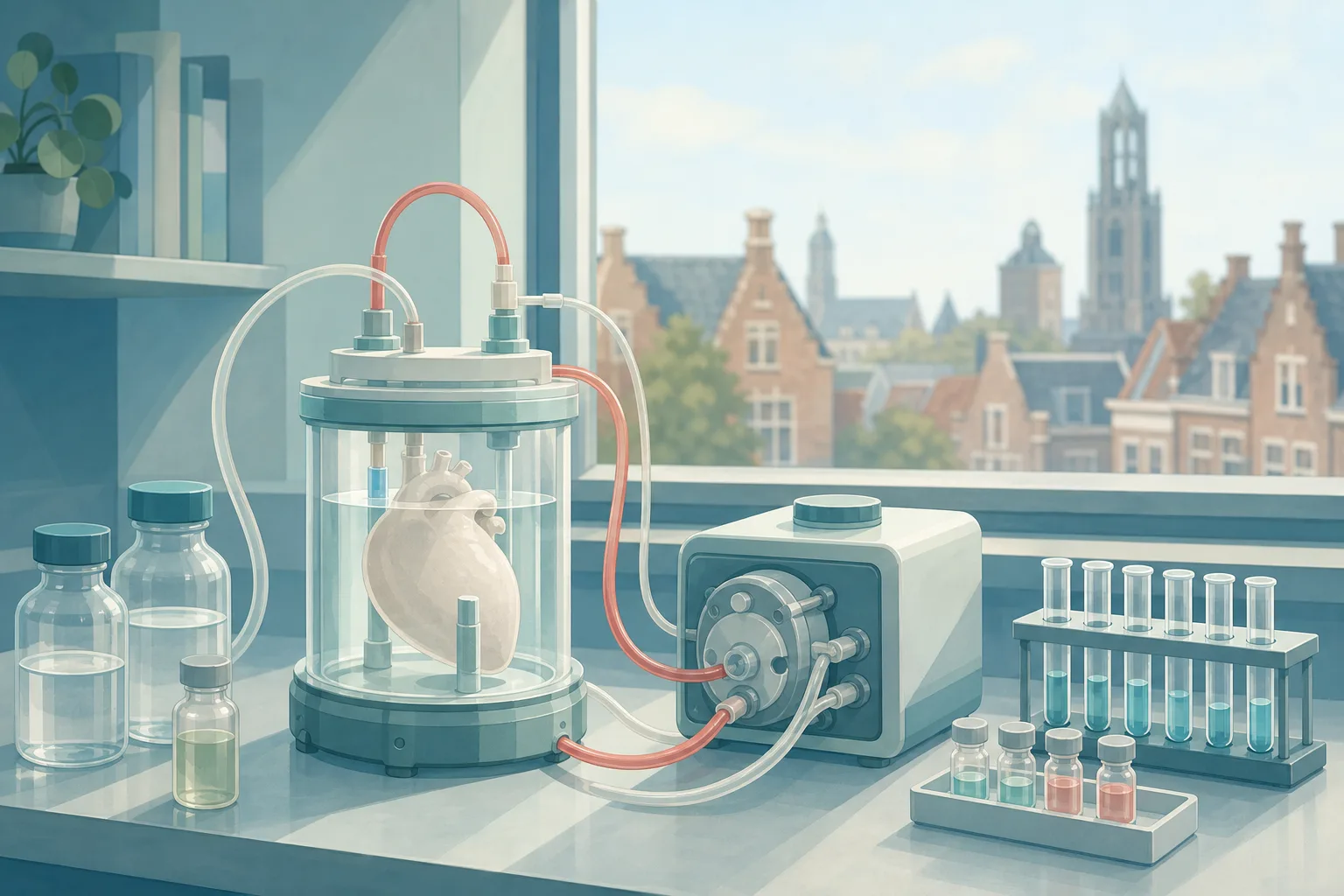
Every day, people wait for a donor organ. A doctoral project at UMC Utrecht and Utrecht University looks at a different question: what if the organ could be treated before it is ever transplanted? According to a news item published by UMC Utrecht on 23 October 2026, researcher Irina Filz von Reiterdank has described the first reproducible method for genetically modifying complete donor organs, and the first detailed account of how to do it reliably.
Keeping an organ alive outside the body
The approach relies on machine perfusion, a technique that keeps an organ supplied with oxygen and nutrients outside the body. UMC Utrecht explains that this buys time to study or treat the organ. Filz von Reiterdank, whose work combines plastic surgery and transplantation medicine, used that window to modify the organ genetically.
The hospital says the work was not quick. "Het kostte anderhalf jaar voordat de genetische modificatie van organen werkte" – it took a year and a half before the modification worked – she is quoted as saying, and many experiments did not give the desired result along the way.
What it could mean for patients
UMC Utrecht presents rejection signalling as an experimental result: a genetically modified organ can release a biomarker when rejection begins. The hospital says the biomarker might eventually be measured with a simple blood test, which could be less invasive than the biopsy-based approach currently used.
Separately, the researcher combined new cooling techniques with machine perfusion. UMC Utrecht reports that this extended the storage time for complex grafts, such as hands or faces, from about six hours to days. "Meer tijd betekent betere zorg", she says: more time means better care.
A longer-term idea is autotransplantation, in which a patient's own organ would be genetically corrected and returned. In that scenario, she says, "hoeft niet langer het hele afweersysteem van een patiënt te worden onderdrukt" – the patient's whole immune system would no longer need to be suppressed.
Still experimental
It is important to separate what has been shown from what is hoped for. UMC Utrecht describes the research as experimental and says it is being scaled up to larger animal models. The hospital presents biomarker release as a preclinical result, while clinical blood-test use and self-treating organs remain future goals. Filz von Reiterdank hopes the first human applications could come within a few years; that is a hope, not a confirmed timeline.
The wider field is also actively discussing the ethics. In 2025, Filz von Reiterdank was first author of a review in the Annual Review of Biomedical Engineering, "Designer Organs: Ethical Genetic Modifications in the Era of Machine Perfusion", with co-authors including Utrecht plastic surgeons J Henk Coert and A B Mink van der Molen. According to the abstract held in Utrecht University's repository, the authors suggest that perfusion could make engineered transplant organs feasible and could improve graft survival, while raising ethical and regulatory questions. They propose a roadmap that pairs scientific milestones with what they call anticipatory governance.
Why it matters for Utrecht
UMC Utrecht is one of the Netherlands' university medical centres, and this is the kind of early-stage research that rarely makes English-language news. For residents, nothing changes in the clinic yet. But it shows where transplant research in the city is heading: treating the organ itself in the hours or days between donor and recipient, rather than only managing the patient afterwards.
Sources
- Preserveren, Bewerken, Transplanteren: de toekomst van donororganen
Published by UMC Utrecht
- Designer Organs: Ethical Genetic Modifications in the Era of Machine Perfusion
Published by Annual Review of Biomedical Engineering / Utrecht University repository