
Attributed reporting
Utrecht researchers join €10m and €14m ERC projects on deep life and Antarctic ice
Two Utrecht University scientists have joined newly awarded ERC Synergy Grant teams that plan to investigate deep-rock microbes and Antarctic ice-shelf stability.
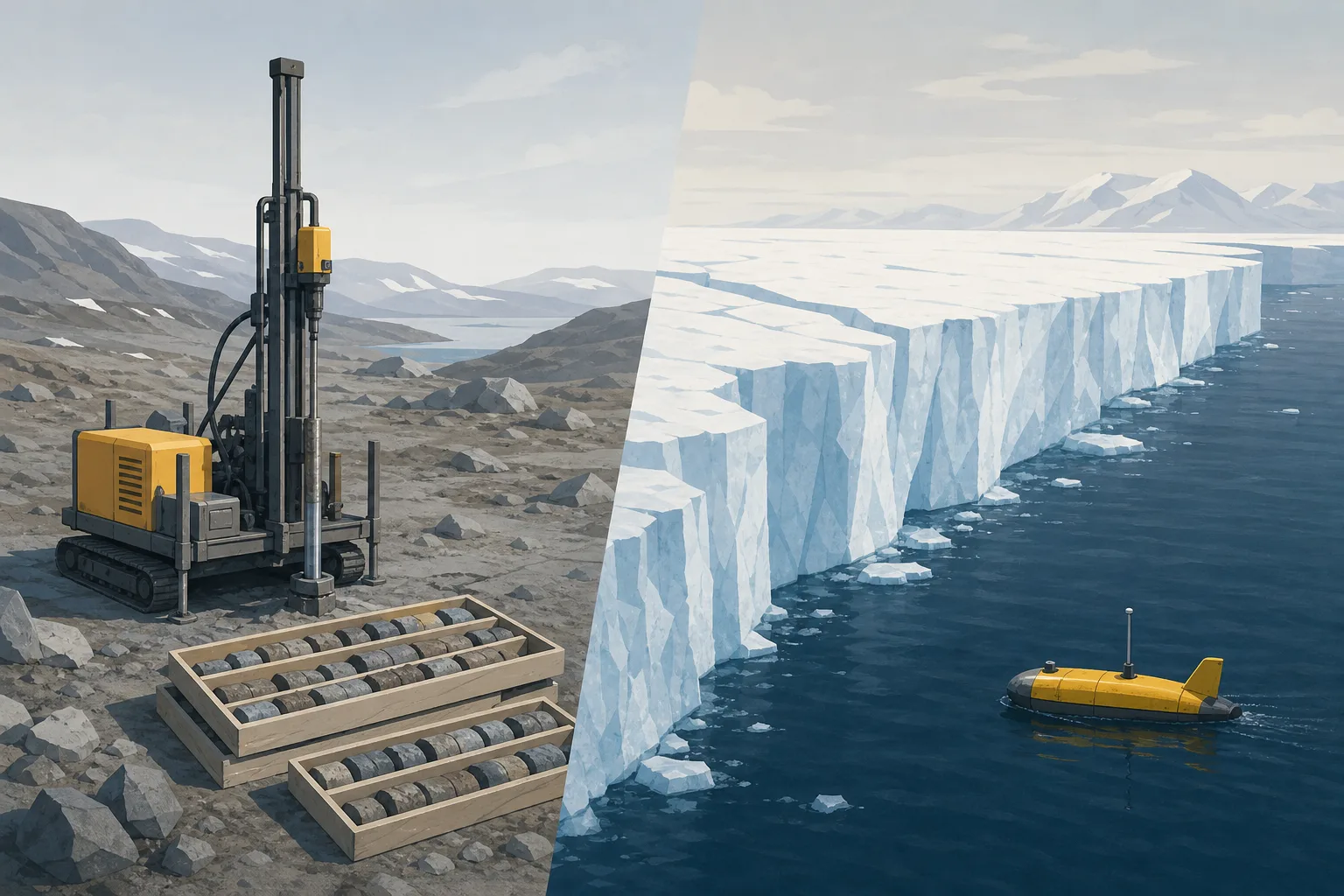
Utrecht University announced on 12 November 2026 that researchers there are involved in two European Research Council (ERC) Synergy Grant projects. The grants go to small teams of researchers whose questions, in the ERC's framing as relayed by the university, are too ambitious for any one scientist. One project plans to search for unknown microbes more than a kilometre below the surface; the other will study why Antarctic ice shelves stay stable or fail.
DEEP-LIFE: microbes in deep rock
The first project has a €10 million grant over six years and is called DEEP-LIFE. Daniel Tamarit, an assistant professor at Utrecht University's Biodynamics and Biocomplexity institute, leads the evolutionary analysis. His partners are Henrik Drake and Mark Dopson of Linnaeus University and Stefan Bertilsson of the Swedish University of Agricultural Sciences.
According to the university, the team plans to search for previously unknown microorganisms living in rock and in the fluids trapped inside it, and to work out what they are and how long they have been isolated. Their genetic material could say something about how life evolved, possibly billions of years ago. The team plans to target sites whose deep conditions may have stayed suitable for life for over a billion years, and one of the first potential drilling sites is in Scandinavia, using the Swedish Riksriggen drilling rig.
The university lists the difficulties plainly: keeping out contamination from microbes nearer the surface, and extracting enough DNA from very sparse microbial communities. The Swedish partners cover geology and sequencing of very low-concentration samples; Tamarit analyses what any new microbes reveal about evolutionary history. "The dream would be to discover microbes that are very different from anything we know today," Tamarit said. The discovery is a hope, not a result yet.
SKUA: why ice shelves hold or break
The second project has a €14 million grant over six years and is called Stability and Known Unknowns of Antarctic ice shelves, or SKUA. Roderik van de Wal, who works at both KNMI (the Dutch weather institute) and Utrecht University, will lead the modelling of observed processes. The four project leaders are Anna Wåhlin of the University of Gothenburg, Ruth Mottram of the Danish Meteorological Institute, Peter Davis of the British Antarctic Survey and Van de Wal.
Ice shelves act as barriers that slow glaciers sliding into the sea. The team will study how warm seawater melting the ice from below, snowfall adding weight, and cracks and shearing inside the ice interact. The work centres on the 400-kilometre Riiser-Larsen Ice Shelf in East Antarctica, with several expeditions planned; the first is planned for early 2028. An underwater robot, Ran II, is intended to map the underside of the shelf. It replaces Ran, which was lost beneath the Dotson Ice Shelf in January 2024.
"Despite their importance, we still don't fully understand what affects the stability of these vast ice shelves," Wåhlin said. The findings will feed computer models meant to improve predictions of Antarctica's contribution to sea-level rise.
What it means for Utrecht
Neither project is a local service, and results are years away. The Utrecht share of each grant has not been broken out in the university's announcement. What the grants show is that Utrecht scientists are partners in large international teams, in evolutionary biology and climate science. The Utrechter Post will report on results as they are published.
Sources
- ERC Synergy Grant for research into the hidden history of life deep underground
Published by Utrecht University
- ERC Synergy Grant for research into Antarctica's ice shelves
Published by Utrecht University