
Attributed reporting
Utrecht students build dome from fungus-grown panels
Master's students at Utrecht University have built the ReGreen Hut, a shelter of fungus-grown panels, and it is due to become a living lab at Utrecht Science Park.
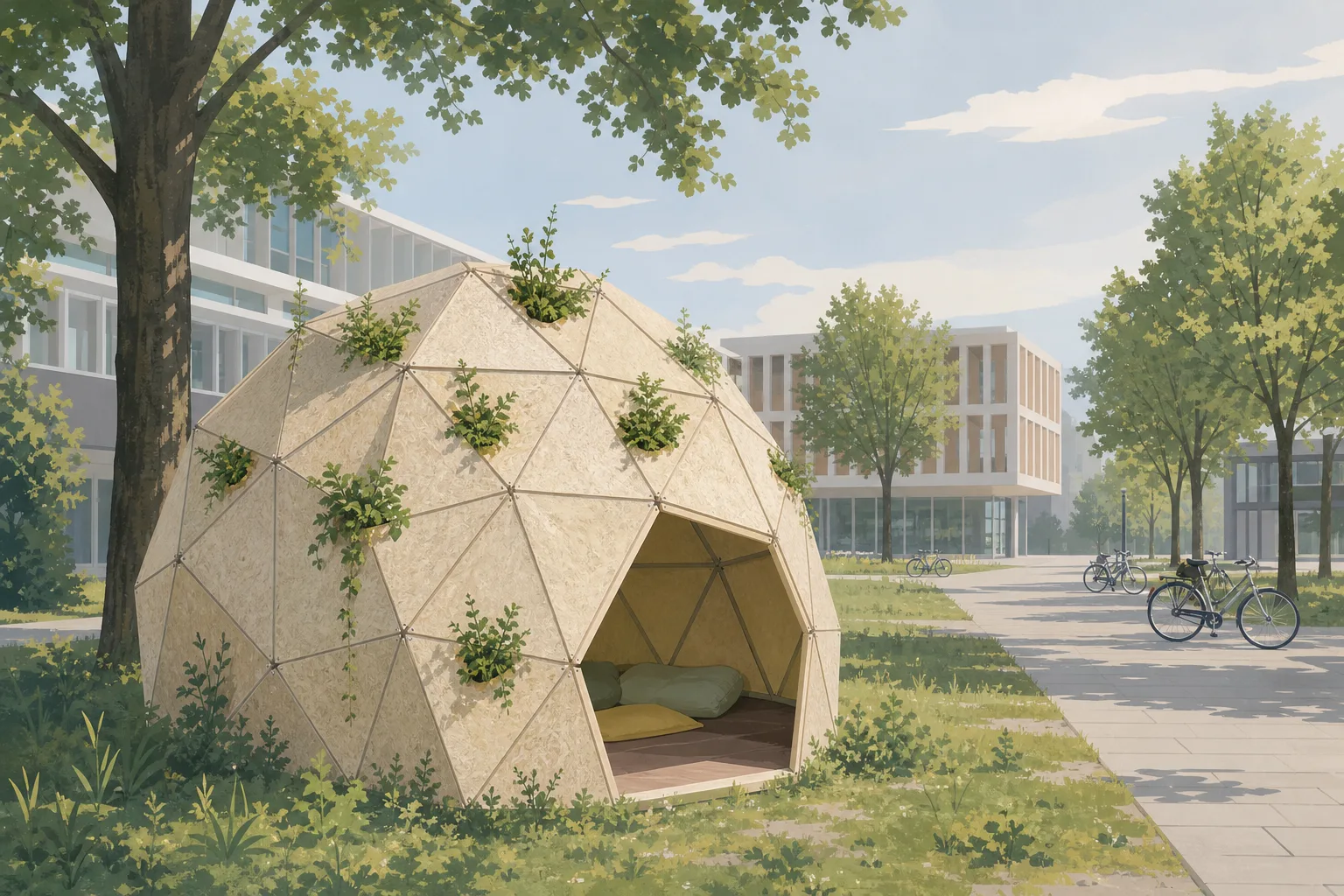
A small dome made partly of fungus is heading for Utrecht Science Park. Master's students at Utrecht University built the ReGreen Hut, a sheltered meeting place made of panels grown from hemp fibres and mycelium, the thread-like body of a fungus. According to the university, it was shown at Dutch Design Week in Eindhoven and will move to the science park, opposite the university's Sustainability Office, where it will serve as a "Living Lab".
How the panels are made
Utrecht University says each panel starts as a mix of hemp fibres and mycelium in a triangular mould. The fungus grows threads through the mix and partly consumes the fibres, producing a solid composite. Each large triangle is made of four smaller triangles grown separately. After about a week, the university reports, the smaller sections had fused into one piece.
The Dutch Design Week programme describes the material as a renewable composite grown through hemp shives, a waste product, with thermal and acoustic insulating properties. Seeds or plants are added once the mycelium has grown through. The aim, it says, is to cover the whole dome with biobased panels that support plant growth without losing structural strength.
The panels can be replaced one at a time, so experiments can go on without rebuilding the dome. The students tested questions such as whether seeds germinate in the panels and whether plants can be repotted into them. Student Evelyn Roelen said that "we added lime to the mixture to see whether we could optimise the acidity for plant growth."
A student project with local partners
The hut was designed by five students on the Bio Inspired Innovation master's programme: Dunya Handor, Evelyn Roelen, Marit Liefting, Monte de Snoo and Tessa van Schaik. It was their Major Innovation Project. Microbiology professor Han Wösten set the challenge. The university's Campus & Facilities and the Centre for Living Labs were the case owners, according to the Dutch Design Week listing.
The frame was built by Level Vijf, an Amsterdam social enterprise that supports people returning to work. Other partners named by the university include VCOA, Hogeschool Utrecht, GeLUK and Het Huis dat Leeft. The Dutch Design Week page says the original dome design came from the Sustainable City Challenge Utrecht 2023.
What is still unknown
The hut is a prototype, not a finished building product. The university lists open questions for the Living Lab: how well the panels withstand rain and weather, how long they last, and which plants do well in them. The Dutch Design Week page says the work is part of Healthy Heidelberglaan, a living lab on making the Heidelberglaan healthier and more climate-adaptive, and that the research is meant to inform the area's upcoming redevelopment. It frames the panels as a possible answer to urban heat, biodiversity loss and poor rainwater management. Those are the organisers' stated aims; no results have been published yet.
Neither source gives a date for the move to the science park. For residents, the practical upshot is that a public-facing experiment in living building materials is due to appear on Utrecht's largest knowledge campus, and its weathering results may help show how far the idea can go.
Sources
- Students present ReGreen Hut at Dutch Design Week
Published by Utrecht University
- Living lab: ReGreen Hut
Published by Utrecht University
- The ReGreen Hut
Published by Dutch Design Week