
Attributed reporting
Utrecht researchers find "silent" vultures have a rich vocabulary, with clues for zoo breeding
A master's thesis at Utrecht University logged 16 call types in Rüppell's vultures, and the findings could help zoos breeding the critically endangered bird.
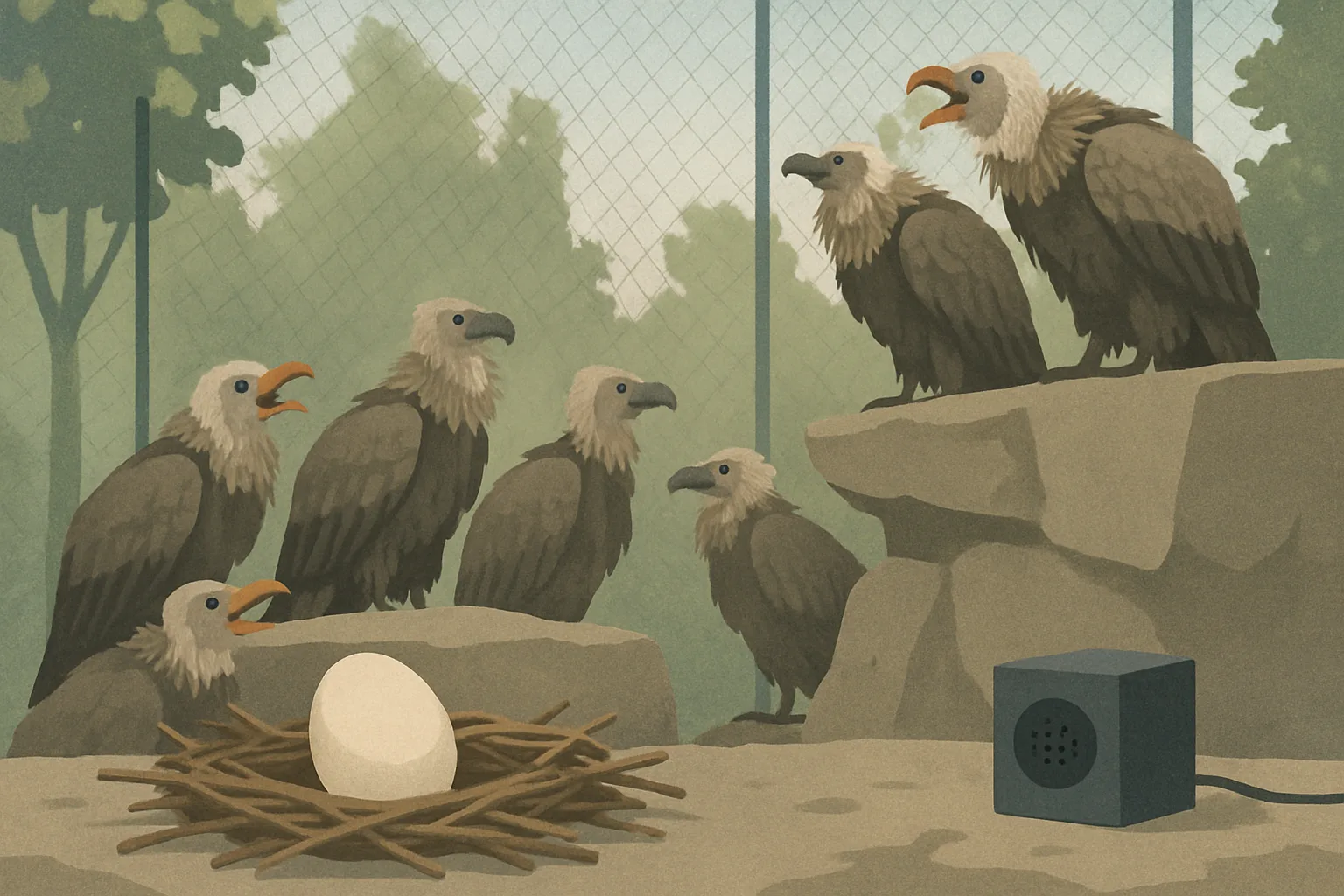
Vultures have a reputation for being fairly quiet birds. Researchers at Utrecht University say that reputation is wrong, at least for one critically endangered species. According to a university news item published on 21 October 2026, Rüppell's vultures use a much wider range of sounds than scientists assumed, and the finding may be useful for zoos that try to breed them.
What the study did
The work began as a master's thesis by Connor Proudfoot in the Vulture Cognition Lab of Jorg Massen, part of Utrecht University's Animal Behaviour and Cognition group. Proudfoot recorded the birds for 150 hours at two colonies in the Netherlands: Diergaarde Blijdorp and Avifauna. Because eggs at Blijdorp are incubated artificially, the team could also record eggs and chicks there.
In total the researchers collected 2,500 vocalisations. For each one they measured the duration and pitch and counted the syllables or notes. The results were published in the journal *PLOS One* under the title "The complex, graded vocal repertoire of the social Rüppell's vulture". Co-authors are Charissa N. Brons, Maarten W. A. Vis, Anne Marijke Schel, Eva S. J. van Dijk and Massen.
Sixteen calls, some blending into others
The team identified 16 distinct call types. Some were clearly separate, while others shaded into one another. The university says this suggests flexible, "graded" communication, in which a bird can signal not only that it is excited but how excited it is. "That blending of calls shows there is flexibility in how the birds communicate," Proudfoot says in the university's account.
For comparison, the university cites a study of more than 800 bird species that found an average of six to eight calls per species. Rüppell's vultures therefore sit well above the typical bird. Proudfoot says they communicate vocally "in ways similar to macaques and other monkey species".
Rüppell's vultures live in the Sahel and East Africa and are listed as Critically Endangered on the IUCN Red List. They are social birds that breed in colonies of up to about 1,000 individuals.
Why it matters for zoos
One finding concerns the youngest birds: chicks begin calling inside the egg about two days before hatching. The researchers suggest that parents in zoos, where eggs are sometimes incubated artificially, may be less prepared for hatching if they cannot hear the chicks from within the egg. They also suggest that playing recorded calls through speakers might encourage more pairs to breed. Both are suggestions from the research team, not tested interventions.
There is a broader scientific question too. A long-standing idea holds that more social species have more complex communication. Primates appear to fit the pattern, and vultures offer a way to test it more widely, because some species are highly social and others are not despite similar habitats and diets.
What comes next
Proudfoot's work earned the UU Vliegenthart Prize and the KHMW Young Talent Award for Life Sciences. The university says he hopes to continue with a PhD if funding can be found. Planned follow-ups include a 3D-printed egg with a built-in speaker to study calls before hatching, more recordings, and AI tools to analyse larger datasets.
This summary relies on Utrecht University's own news item and the study it describes; The Utrechter Post has not independently reviewed the paper's data.
Sources
- 'Silent' vultures turn out to use a wide range of sounds to communicate
Published by Utrecht University
- The complex, graded vocal repertoire of the social Rüppell's vulture
Published by PLOS ONE