
Attributed reporting
Utrecht study: solar cells that let the right colours through to plants
Utrecht and Wageningen researchers tested semi-transparent solar cells that share sunlight between power generation and plant growth, and found that cell colour matters.
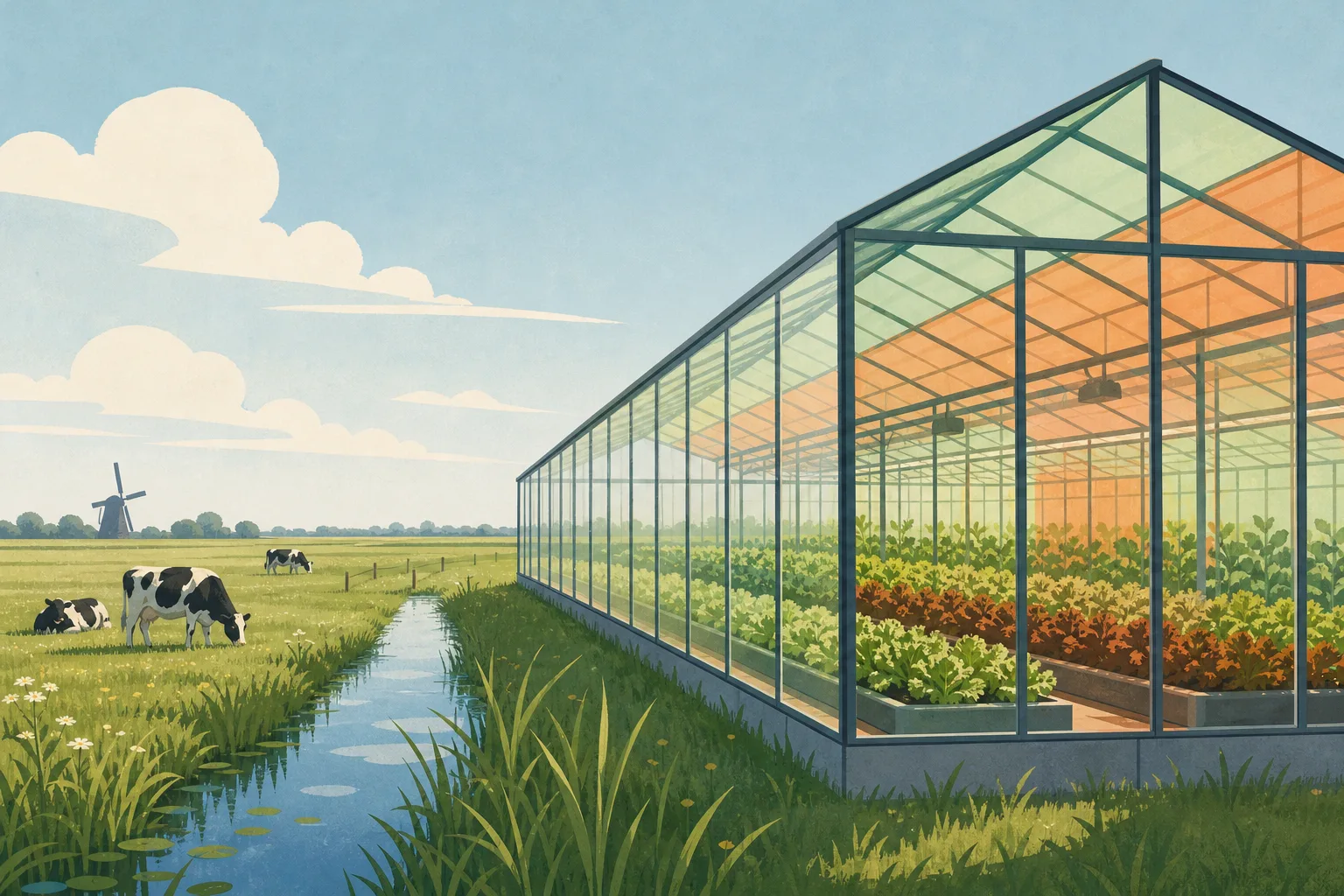
Land in the Netherlands is scarce, and the same plot is often wanted for both farming and solar power. Researchers at Utrecht University and Wageningen University & Research have now tested one way to ask less of the land: solar cells that are partly see-through, so that plants underneath still get the light they need.
Utrecht University announced the work on 17 November 2026. The study appears in the journal Nexus under the title "Synergistic photon use in semi-transparent photovoltaic-photosynthesis systems for agrivoltaics". Lead author Hugo de Boer is an environmental scientist at Utrecht University's Faculty of Geosciences. The co-authors are Raimon Terricabres-Polo, Steven Driever, Wilfried van Sark, Celso de Mello Donega and Tinko Jans; the university links the study to the Faculty of Geosciences and the Copernicus Institute of Sustainable Development.
The problem with panels over meadows
According to the university, solar panels installed on Dutch and European meadows block light and so limit what can grow underneath. The approach tested here is known as agrivoltaics: semi-transparent solar cells let some colours of light pass through to the plants and use the rest to generate electricity.
What the researchers did
The team developed a lab-scale method to work out which split of light is most efficient for photosynthesis and power generation at the same time. The experiment placed four differently coloured, 70 by 70 millimetre luminescent solar concentrators lined with silicon photovoltaic cells between a tunable light source and a leaf. The photosynthesis measurements used high-light-adapted sunflower and shade-tolerant calathea.
The researchers compared the combined electricity generation and photosynthesis with separate opaque solar cells and leaves under equal light. For sunflower under the highest tested light, green and orange concentrators produced a combined photon-use result above that reference. The official paper record describes this as synergistic photon use. The result was not reported for every plant, colour or light level.
What it could mean
The authors suggest the approach could suit farming and solar generation where space is limited, and could be used on greenhouses. Their method is meant to help identify the best cell colour for different agricultural and horticultural uses.
What is still unknown
This is a laboratory research result, not a product on sale or a farm trial. It measured photosynthesis in individual leaves rather than crop growth or harvest yield, and the researchers say more work is needed. The study does not establish commercial cell efficiency, costs, durability or performance across a growing season under real-world conditions.
For Utrecht, the story is a reminder that the city's university is working on questions of land use and the energy transition, not only in the lab but in ways that could eventually reach greenhouses and fields across the Netherlands.
Sources
- Plants and solar panels can share sunlight
Published by Utrecht University
- Synergistic photon use in semi-transparent photovoltaic-photosynthesis systems for agrivoltaics
Published by Nexus