
Service information
Look west tonight: Utrecht gets a near-90% solar eclipse
The Moon covers about 90% of the Sun's diameter over Utrecht this evening — the largest solar eclipse over the Netherlands since 1999, and the last of this size until 2081. It starts at 19:16, peaks at 20:11 and ends at 21:03, with the Sun only eight degrees above the horizon. You will need a clear western view, and eclipse glasses throughout.
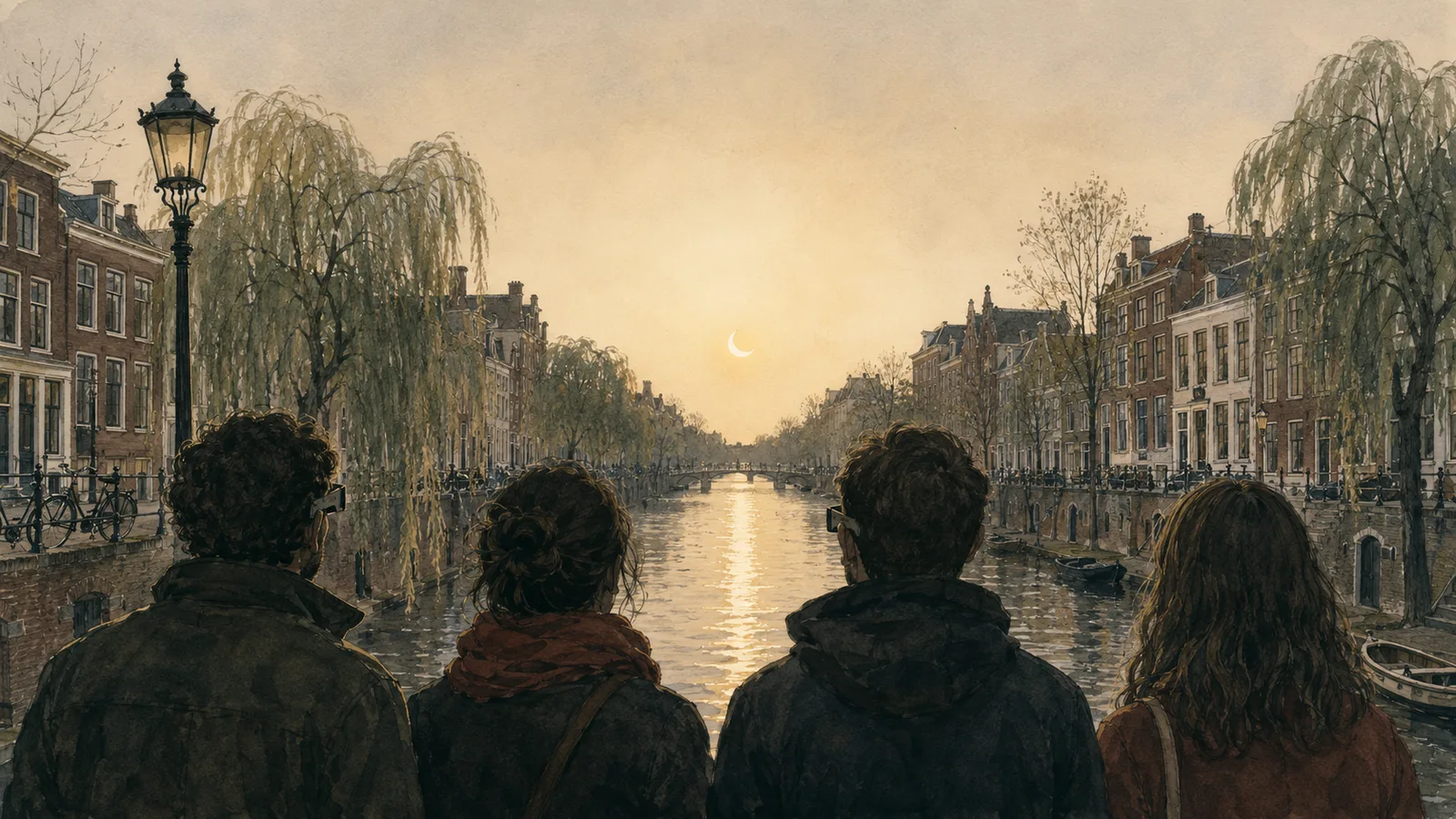
A deep partial solar eclipse is visible from Utrecht this evening. It begins at 19:16, reaches its maximum at 20:11 and ends at 21:03, shortly before sunset.
At maximum the Moon covers about 90% of the Sun's diameter — around 88% of its visible surface. What is left will appear as a thin, bright crescent, low in the western sky. This is the largest solar eclipse over the Netherlands since August 1999, and the next one of comparable size here is not until 3 September 2081.
Utrecht will not see totality. The total phase crosses parts of Greenland, Iceland and northern Spain; from the Netherlands the eclipse remains partial throughout. Even so, the light should dim noticeably around the maximum.
When and where to look
First contact is at 19:16, maximum at 20:11, and last contact at 21:03. The times shift by a minute or so depending on exactly where you stand.
Look west to northwest. This is the part that will decide whether you see anything at all: at maximum the Sun sits only about eight degrees above the horizon — roughly the width of your fist held out at arm's length. Buildings, trees and even a low roofline will be enough to hide it.
A bridge, a park, an open square or a stretch of waterfront with an unobstructed western view is worth the walk. A narrow street is not going to work.
Sonnenborgh Museum and Observatory, which would be the obvious place to go, is closed during the eclipse for exactly this reason — it says the view of the western horizon from the observatory is not good enough. The observatory has also sold out of eclipse glasses entirely because of demand.
Watch safely
Use proper eclipse glasses. Ordinary sunglasses do not protect your eyes, and looking at the Sun through binoculars, a telescope or a camera lens without a dedicated solar filter can cause serious and permanent damage.
Because the eclipse stays partial over Utrecht, eye protection is needed for the entire event. There is no point at which it is safe to look at the Sun directly. The crescent remaining at maximum is still roughly a tenth of the Sun's face, and it is as damaging to look at as the Sun on any ordinary day.
If you have no eclipse glasses, watch indirectly instead. A pinhole in a piece of card, held so it projects the Sun's image onto a second white surface, shows the crescent safely — and so does the dappled light under a leafy tree, where every gap between the leaves acts as its own pinhole.
After sunset
There is a second reason to stay out. The Perseid meteor shower is near its peak tonight, and a solar eclipse only happens at new moon — so there will be no moonlight at all to wash the sky out. Once the Sun has set and the sky has darkened properly, conditions for meteors are about as good as they get.
What we could not verify
Cloud cover is the one thing nobody can promise. Check a forecast before you commit to a spot, and give yourself a few minutes to find an open horizon.
Sources
- Gedeeltelijke zonsverduistering 12 augustus 2026
Published by Koninklijke Nederlandse Vereniging voor Weer- en Sterrenkunde (KNVWS)
- Wo 12 aug: Grote zonsverduistering in Benelux
Published by Sonnenborgh Museum & Sterrenwacht
- Totale en gedeeltelijke zonsverduistering 12 augustus 2026
Published by Zonsverduistering.nl
- Grootste zonsverduistering in decennia: bijna 90 procent van de zon verdwijnt op 12 augustus
Published by Scientias
- Solar Eclipse of August 12, 2026 from Utrecht (Netherlands)
Published by TheSkyLive