
Attributed reporting
Utrecht geologist helps reconstruct two great leaps in ancient mountain height
A study co-authored by Utrecht professor Douwe van Hinsbergen reconstructs two stepwise increases in mountain-belt height and proposes links to land emergence, oxygenation and habitability.
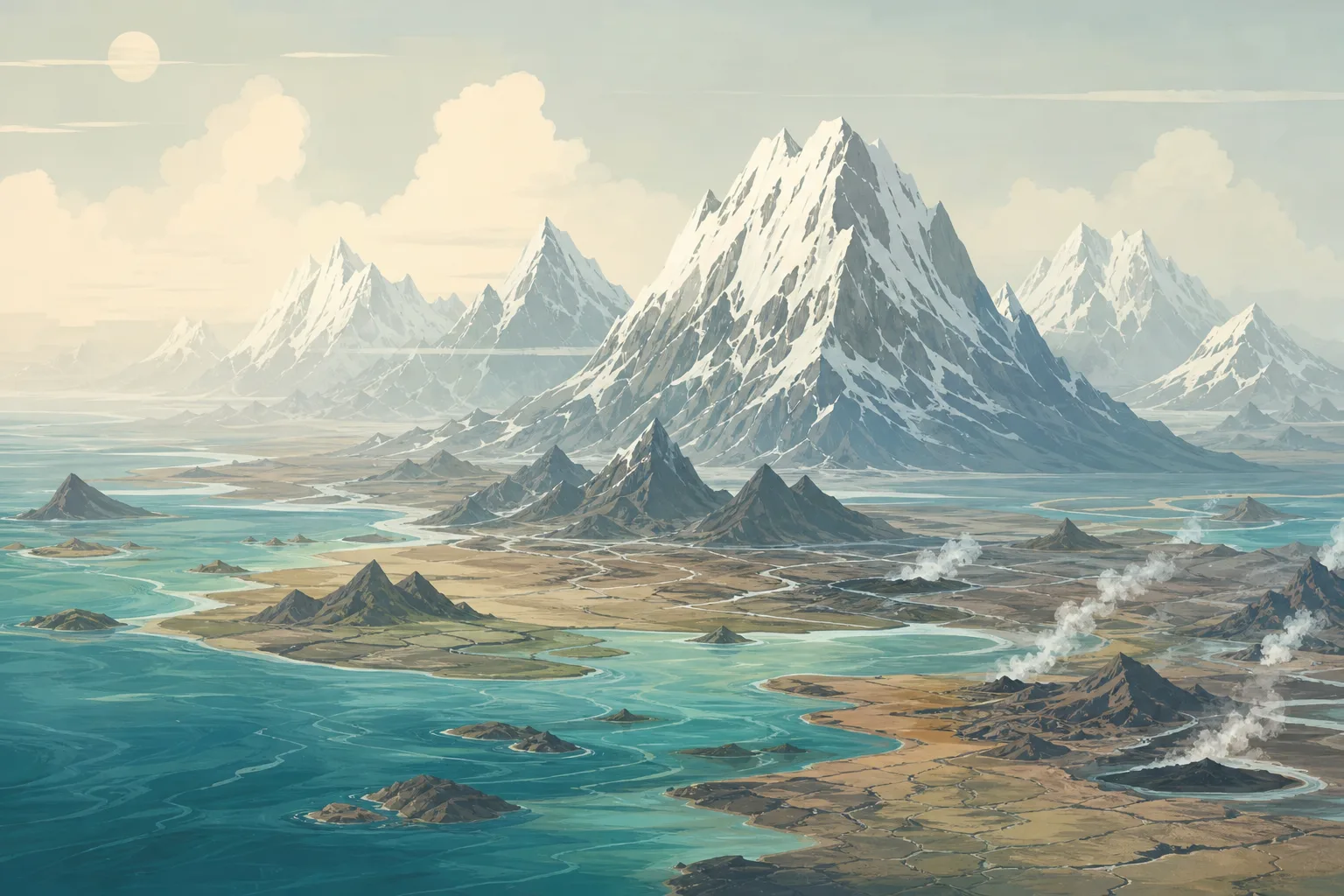
A new study co-authored by a Utrecht University professor reconstructs two stepwise increases in the maximum thickness and height of mountain belts over billions of years. The authors propose that the changes may have reshaped nutrient cycles and helped create conditions in which complex life could develop.
Utrecht University announced the research on 13 November 2026. The paper, "Raising mountains for a habitable Earth", appears in Science Advances. Its lead author is Matthijs Smit of the University of British Columbia in Vancouver, a Utrecht alumnus. The Utrecht co-author is Douwe van Hinsbergen, Professor of Global Tectonics and Paleogeography. Ellen Kooijman of the Swedish Museum of Natural History, also a Utrecht alumna, is among the other authors.
Two reconstructed jumps
The researchers used pressure estimates from metamorphic rocks that had been buried near the roots of ancient mountain belts and later returned towards the surface. From those records, they reconstructed the maximum thickness of mountain-belt crust through time.
They report two increases, roughly 2.2 to 2.3 billion and 800 million years ago. The estimated maximum crustal thickness rose first from about 30 to 60 kilometres and later to nearly 90 kilometres. Depending on the assumptions used to convert thickness into elevation, this corresponds to maximum mountain heights increasing from about 1 to 1.5 kilometres, to roughly 4.5 to 5 kilometres, and then to almost 9 kilometres.
These are estimates of the upper limits that mountain belts could sustain in each era, not measurements showing that every mountain range grew at the same time.
Why the authors think it happened
The authors hypothesise that the two changes ultimately resulted from geological responses to the Earth's gradual cooling. As the planet cooled, its crust and tectonic plates changed in strength and behaviour, allowing colliding continents to build thicker crust and taller mountain belts.
Van Hinsbergen told Utrecht University that the crust became increasingly stiff and able to bear more weight. The published abstract describes cooling as the proposed underlying explanation, rather than a directly demonstrated cause.
Proposed consequences
The paper links the first growth spurt to widespread land emergence and the second to mountain belts comparable in scale with the modern Himalaya-Tibet system. The authors argue that taller mountains would have increased erosion and the flow of rock-derived nutrients into the oceans.
The timing also overlaps with major changes in biological sulphur metabolism and atmospheric oxygen, while two of Earth's most intense icehouse episodes followed the growth spurts. The authors present enhanced weathering as a possible mechanism connecting these events. The study does not establish that mountain growth alone caused oxygenation, ice ages or the evolution of complex life.
What this means for readers
This is basic research about deep time rather than a local project, and it has no direct bearing on daily life in the city. Its Utrecht interest is in the university's tectonics and earth-science research and in the contribution of its staff and graduates to an international study of planetary habitability.
The study is an observational reconstruction, not an experiment. Its public manuscript says the analysis combines existing and new pressure and age estimates from metamorphic rocks, and lists support from Canada's Natural Sciences and Engineering Research Council. The peer-reviewed paper and its abstract are available through DOI 10.1126/sciadv.aei2764.
Sources
- Raising mountains for a habitable Earth
Published by Science Advances
- Raising mountains for a habitable Earth
Published by Research Square
- Did mountains make a habitable world?
Published by Utrecht University
- Mountain growth spurts may have sparked complex life on Earth
Published by University of British Columbia