
Attributed reporting
Utrecht-linked study ties a cuprate pseudogap to electron pairing
Shot-noise measurements link a long-debated energy gap to Cooper pairs. Researchers say phase coherence may limit higher-temperature superconductivity, but they did not demonstrate room-temperature superconductivity.
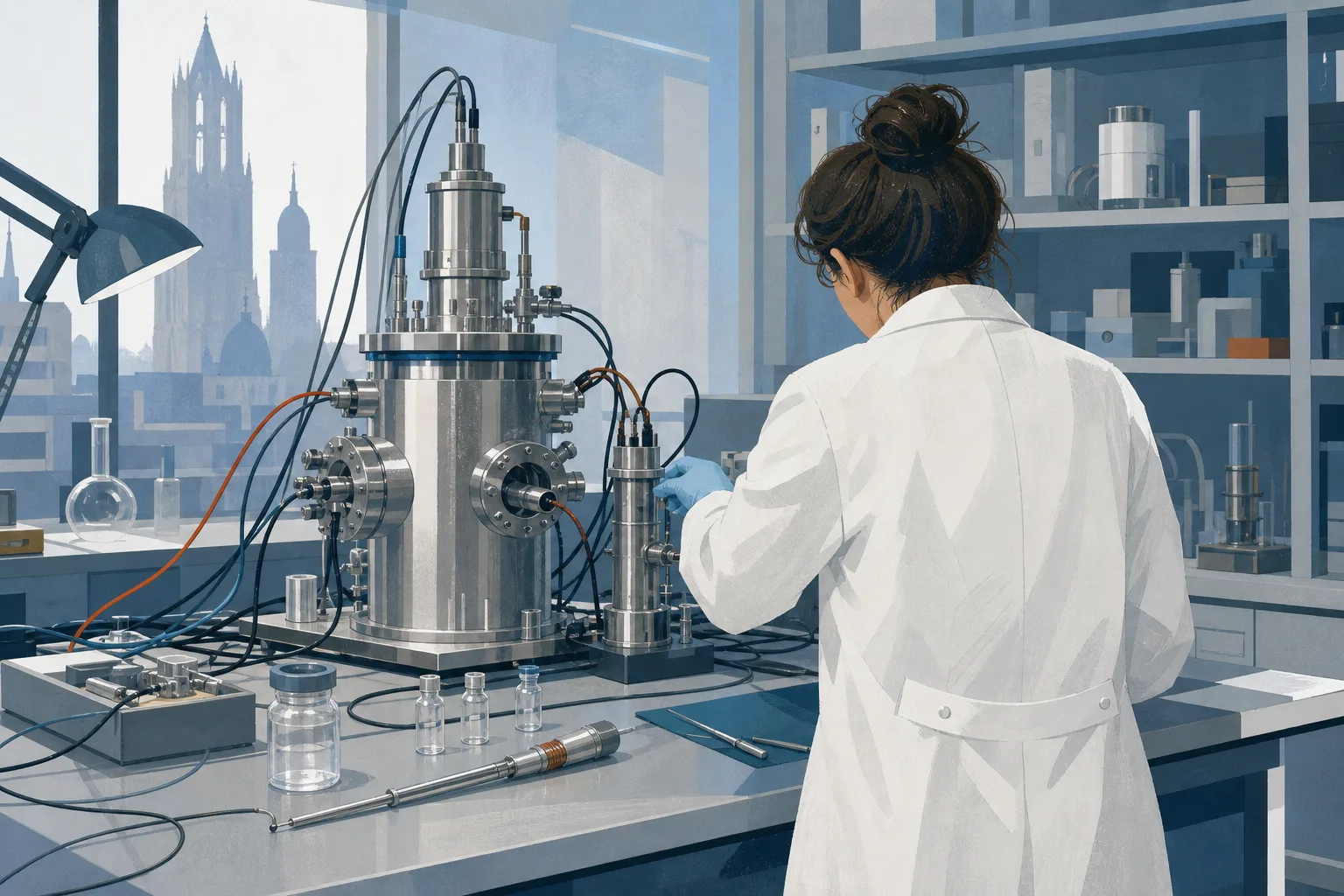
An international research team including Utrecht University scientists has linked a long-debated feature of a cuprate material to electron pairing. The result, published in *Science* on 5 November 2026, suggests that phase coherence may be the factor limiting superconductivity at higher temperatures. It does not demonstrate room-temperature superconductivity.
The paper lists researchers affiliated with Leiden University, LMU Munich, Utrecht University, Delft University of Technology, the Max Planck Institute for Chemical Physics of Solids and Brookhaven National Laboratory. Utrecht researchers Maialen Ortego Larrazabal and Ingmar Swart are among the authors; Jiasen Niu and Ortego Larrazabal contributed equally as first authors.
Pairing and phase coherence
Superconductivity requires electrons to form Cooper pairs and those pairs to move coherently. In conventional superconductors, pairing and phase coherence emerge together below a critical temperature. In cuprate high-temperature superconductors, the relationship between pairing and the higher-temperature "pseudogap" has remained contested.
The team studied the cuprate compound Bi₂Sr₂CaCu₂O₈+δ using local shot-noise spectroscopy. The equipment can distinguish current carried by single electrons from current associated with electron pairs.
According to the paper's abstract, the measured pseudogap energy coincides with the onset of electron pairing and varies across the material, reaching values of up to 70 milli-electron volts. The authors say the measurements rule out a purely local-order explanation for the pseudogap and support Cooper-pair formation as its origin.
What the room-temperature claim means
The paper concludes that phase coherence appears to limit the critical temperature in the cuprate studied. That is narrower than showing that the material conducts without resistance at room temperature.
In Utrecht University's accompanying news release, Swart interprets the measured pairing energy as evidence that the "glue" holding electron pairs together is strong enough for the pairs to persist at room temperature. This is the researchers' inference from the energy scale, not a direct observation of room-temperature superconductivity.
The release says Swart plans follow-up research on phase coherence. Understanding that second condition could help researchers investigate routes to superconductivity at higher temperatures, but neither the paper nor the university gives a product timeline or claims a working room-temperature superconductor.
Why the result matters
The study addresses a long-running debate over whether the cuprate pseudogap reflects preformed electron pairs or a different form of local order. By linking the pseudogap energy to pairing, the measurements give researchers a more specific question to pursue: what prevents the pairs from becoming phase coherent at higher temperatures?
That makes the work a result in fundamental condensed-matter physics, not a near-term technology announcement. The peer-reviewed paper is published in *Science* under DOI 10.1126/science.adt3444, and an earlier manuscript is available through arXiv.
Sources
- Equivalence of pseudogap and pairing energy in a cuprate high-temperature superconductor
Published by Science
- Equivalence of pseudogap and pairing energy in a cuprate high-temperature superconductor
Published by arXiv
- New research offers hope for room-temperature superconductivity
Published by Utrecht University
- New Research Offers Hope for Room-Temperature Superconductivity
Published by LMU Munich