Attributed reporting
Utrecht University rises to 23rd in construction procurement ranking
Its average tender score rose from 2.00 to 3.27 in a list that measures how procurement encourages sustainable work, not completed building performance.
Utrecht University has made the biggest jump in this year's national ranking of construction clients that encourage contractors to work sustainably. Its average score rose from 2.00 and 80th place last year to 3.27 and 23rd place. The university announced the result on 2 November 2026, and the ranking's publisher, construction trade association Bouwend Nederland, confirmed the same day that no organisation had climbed further.
What the ranking measures
Bouwend Nederland's Top 25 of Sustainable Procurement Organisations is in its eighth year. Its procurement institute scores each registered tender separately and ranks organisations by their average score, with at least seven tenders required for inclusion. Higher scores go to tenders in which sustainability has more weight in awarding the contract, or in which a construction team treats sustainability as a priority.
The ranking does not measure the performance of completed buildings. It measures how procurement encourages contractors to offer more sustainable work. Bouwend Nederland says the average score among the top 25 fell from 3.98 to 3.83, while the share of tenders awarded on sustainability fell from 46.9 to 41.1 per cent. The province of Noord-Brabant ranked first and the municipality of Eindhoven second. The province of Zuid-Holland and the municipality of Helmond also improved sharply.
Three tenders with top scores
The university says three of its tenders received the maximum sustainability score: one for UNIEK, the redevelopment of the Willem C. van Unnik building, and two separate tenders for refurbishing the SL2 building, which will house research groups from the Faculty of Science.
For UNIEK, the university plans to retain the tower's concrete skeleton rather than fully demolish it. It expects that choice to reduce demand for new raw materials and extend the structure's life by at least 50 years. The project page describes UNIEK as still being developed towards construction, so those benefits are intended outcomes rather than measured results.
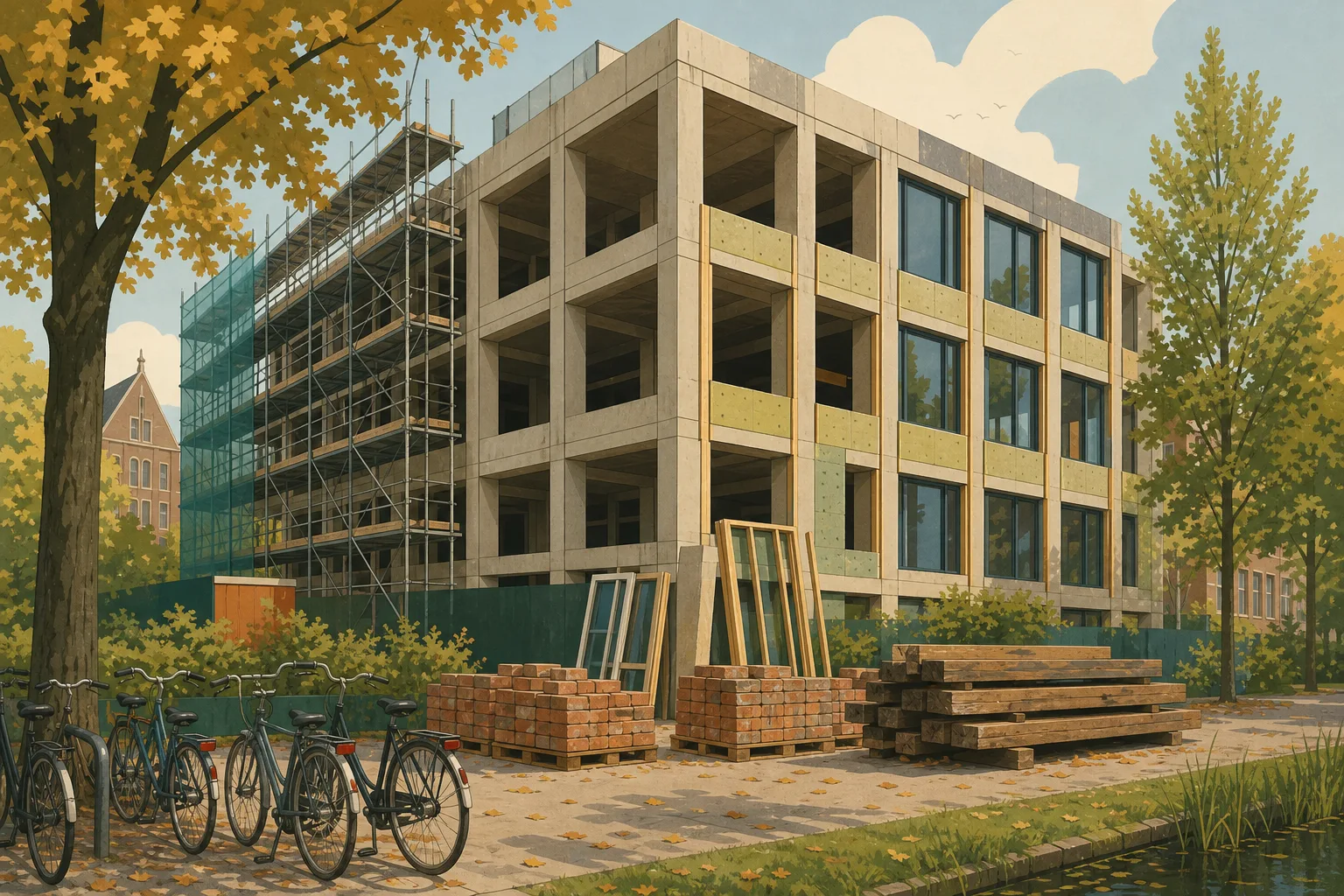
Work on SL2 began in October 2026. The university says the building will largely retain its existing structure and exterior while gaining better insulation, HR++ glazing, heat recovery and an improved connection to the campus aquifer thermal energy storage system.
The university also points to the Anna Maria van Schurman education centre in the city centre. Several listed buildings are being circularly renovated and joined with a replacement for one building that is being demolished. The centre is in the realisation phase and is planned to enter use in 2028.
A modest claim
Jeroen Kingma, the university's Director of Campus & Facilities, said that "with every tender, we can demonstrate which sustainable choices are important to us." He added that the climb reflects the work of colleagues and partner organisations, and that "we're not there yet." He hopes it encourages other organisations to take a bigger step.
The result should be read with care. It shows that sustainability had more weight in the university's registered tenders, not that the finished projects have already delivered lower emissions or material use. Those benefits are the university's expectations and will need to be assessed as the projects are completed and occupied. For Utrecht residents, the ranking is nevertheless a sign that one of the city's largest institutional construction clients is using procurement to press contractors towards more sustainable choices while the national trend is moving towards lower-price awards.
Sources
- Utrecht University is the biggest climber in the Top 25 Sustainable Procurement Organisations
Published by Utrecht University
- Top 25: Helmond, Zuid-Holland en Universiteit Utrecht stijgen sterk
Published by Bouwend Nederland
- Nieuwe puntentelling top 25 duurzame opdrachtgevers
Published by Bouwend Nederland
- Van Unnik to UNIEK
Published by Utrecht University
- Construction begins on the redeveloped SL2 building
Published by Utrecht University
- Anna Maria van Schurman Building Education Centre
Published by Utrecht University